{Three best friends sharing health and wellness ideas to create a positive change}

Friday, March 7, 2014

8 Exercises for Sexy Summer Legs


Thank you for reading ThreeHealthyMommas! Our blog has recently moved over to Wordpress due to complications with blogger format. Please head on over to our new blog and check it out!

 ThreeHealthyMommas.wordpress.com


If you are not automatically redirected, please click here


We all want those fit lean legs especially when summer is just around the corner. But don't worry here are 8 Exercises that will help tighten up your buns and thin your thighs.

1. Weighted Squats: 20 reps


Place a weight that will challenge you upon the top of your back right under your neck and perform a deep squat. Remember to keep your feet shoulder width apart and to not let your knees go over your toes. Keep your shoulders down and torso upright and refrain from dipping forward. Try and squat down as far as you can (think about sitting down in a low chair).

2.  Jump Switch Lunges: 20 on each side for a total of 40 reps


Jump your right leg forward and land in a lunge position. Keep both your hips facing forward and make sure your feet are forward and not turned out. Engage your core and keep your torso stable and not moving. Repeat with your left leg to keep the lunges moving and a fluid pace.

3. Weighted Pogo Right and Left legs: 20 reps on each leg 


Stand on one leg with a weight in the hand that is opposite of your standing leg. Do a squat on the one leg that leads into a jump off the ground. When you squat your arm with the weight is down by your leg and moves pressed above your head when you jump. Remember to have good form with your knee not going over your toes, your hips and foot pointing forward and your upper body staying still. Do 20 reps on one side before switching to the other.

4. Weighted Step Ups: 20 reps on each leg 


Place a Weight on top of your back right under your neck. Step up onto a bench or some other surface with your right leg then bring your left leg up next to it. Step back down off the bench with your right leg starting and have your left leg follow. Perform 20 reps starting with the right leg before moving onto the left leg starting. Remember to your shoulders back and down and to have your upper body still.

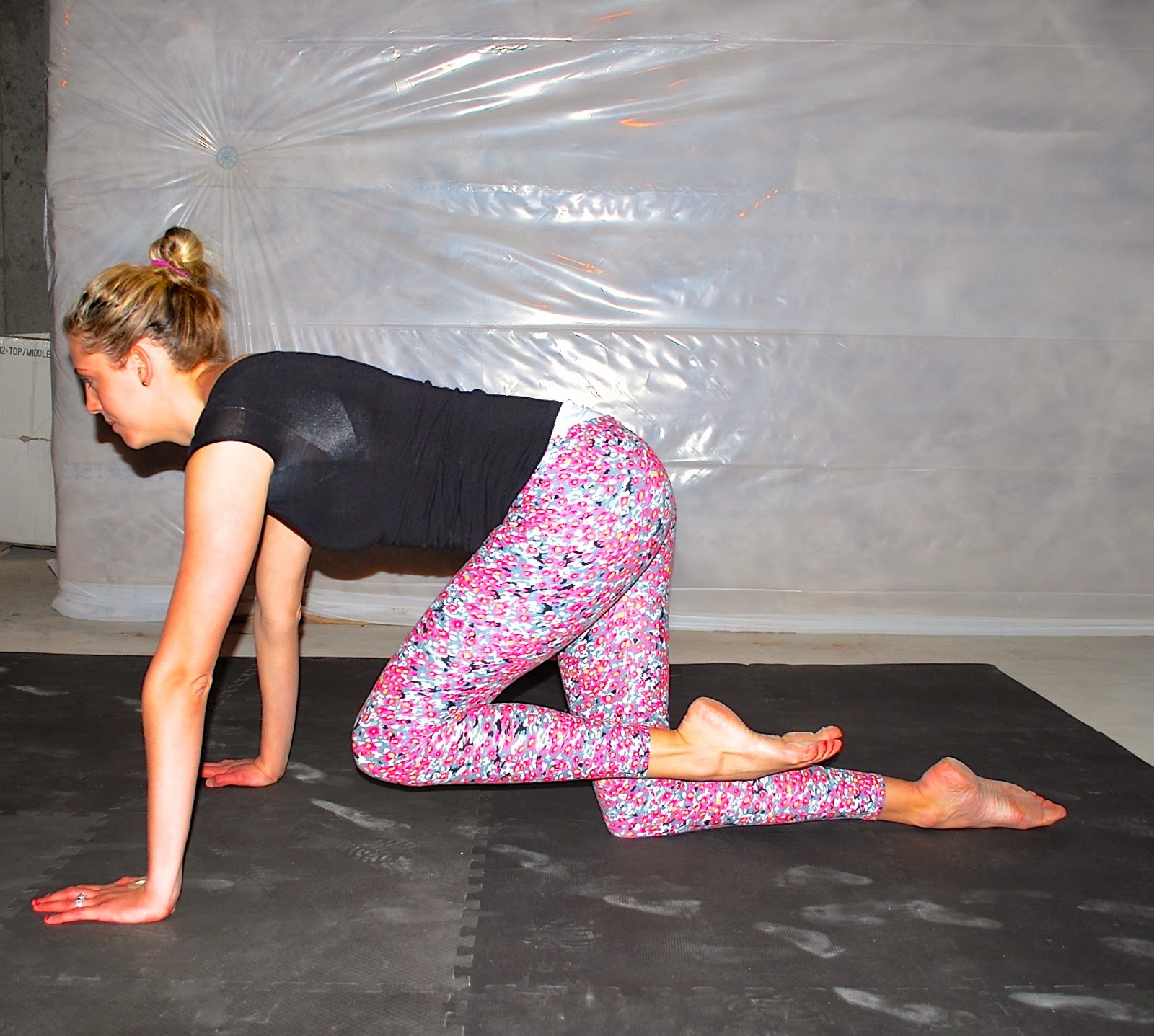
For the next 4 exercises you will perform all 4 completely through on your right side first and then go back and do all 4 again on your left side. You will do each exercise for a full 1 minute before moving onto the next. You will be on the ground on your hand and knees for all of these next exercises.

5. Straight leg Lift: 1 minute on each side


While on your hands and knees lift your one working leg back behind you and then bring it tucked back into your chest. Keep repeating this movement for the full minute. Never let your working leg touch the ground. Keep the rest of your body stable with your back straight and spine in line.

6. L shaped Leg lift and Lower: 1 minute on each side


 While on your hands and knees lift your working leg up behind you to an L shape. Then bring it back down and tucked into your chest. Keep repeating the motion and never let your working leg touch the ground during the full minute. Remember to keep the rest of your body still and under control.

7. Straight leg Cross Over: 1 minute on each side


 While on your hands and knees lift your working leg straight out from behind you. Lower it back down and cross it over to the opposite side of your body. Don't let your leg touch the ground but keep it hovering and then lift it back up again. Keep repeating this movement until the minute is up.

8. Bent leg press to the ceiling 


While on your hands and knees lift your working leg up behind you into an L shape. Keep the leg there and perform slight pulses up and down. Remember to focus on squeezing your bum and keeping it tight will doing this. (helpful tip: think there is a tray of drinks on your foot during the pulses. Keep the foot flat and your leg steady in the L shape).


By the end of this workout your legs and bum should be on fire. If not repeat the whole thing another time through. Also if using weight is to hard during the weighted exercises then leave it out. Adding the weight just makes the movements that much harder. Good luck on working those legs for the summer and let me know how you like this workout.

- Shauna


Thursday, March 6, 2014

Nutrition 101: The Basics

Our blog has moved to ThreeHealthyMommas.wordpress.com


If you are not automatically redirected, please click here

Happy National Nutrition Month!

As we all know, there is A TON of nutrition information all over the place. One day they say something is bad for you and causes all sorts of diseases and the next day it’s the new best thing that is a cure all for all of the diseases it caused before. Well how the heck do we know what to believe?! I am a huge believer of just sticking to the basics. You know the food guide pyramid we all learned about in 6th grade health class? Well the same idea applies, just tweaked a little. The pyramid is now a plate (called MyPlate), which makes a whole lot more sense to me (who eats off of a pyramid? Haha) I am going to summarize the different food groups by using MyPlate.


 As you can see from the picture above, your plate should look a little like this. Fill half of your plate with fruits and vegetables (this is a great tip for portion control also- fruits and vegetables are high in fiber and nutrients and very low in calories. So, you will stay full longer with less calories). A little less than one fourth of your plate should be filled with a lean protein, a little more than one fourth should be filled with a whole grain, and shoot for 3 servings of low fat dairy each day. Here is a little break down of what you should look for when eating each of these food groups.
***Recommedations of how much of each food group you should consume depends on age, height, weight, gender and physical activity. They are not the same from person to person, but I give an average recommendation. Also, children recommendations are usually  lower.

Fruits

Fruits can be fresh, canned, frozen, dried, or puréed. 100% fruit juice counts for a fruit also, but I recommend trying to eat the actual fruit. Juice can have lots of added sugars, so drink it in moderation. When choosing canned fruits, try to choose fruits that have been canned in water or 100% fruit juice and not syrup. Most adults should consume 1 ½ to 2 cups of fruit per day. Examples of 1 cup of fruit: 1 small apple, 1 large banana, 1 cup whole, halved or sliced strawberries.

Fruit has many important nutrients. Try to get a variety of colors when eating fruits…they each have different vitamins and minerals! A few of the many important nutrients found in fruit are potassium, dietary fiber, vitamin C, and folate.

Tips to get more fruit in your diet:

  • Leave them on the counter top so that you can see them
  • Have cut up fruit ready to go in the fridge
  • Include them in meals
  • Eat them for snacks

Vegetables

Any vegetables or 100% vegetable juice can be considered a part of the vegetable group. Vegetables can be raw or cooked, fresh, canned, frozen or dehydrated. Again, try to eat the whole vegetable instead of drinking the juice. If you are using canned vegetables, use ones that say low sodium or no salt added. There are 5 subgroups of the vegetable group: dark green veggies, starchy veggies, red and orange veggies, beans and peas, and other vegetables. Beans and peas are unique because they count as a vegetable, but can also count as a protein.

Try to get a variety of colors of vegetables each week to receive the nutrient benefits from the different vegetable subgroups. Most adults should get 2 ½ - 3 cups of vegetables per day. 1 cup of raw or cooked vegetables, 1 cup of vegetable juice and 2 cups of leafy greens count as 1 cup of vegetables.
Most veggies are very low in calories and fat. They also have no cholesterol. Vegetables are packed with very important nutrients including vitamin A, vitamin C, folate, fiber, and potassium.

Eating a diet rich in fruits and vegetables is associated with a lower risk of heart disease, type II diabetes, and obesity. Eating vegetables and fruits that are high in potassium could help maintain a healthy blood pressure. Since fruits and vegetables are so low in calories and so high in nutrients, they can be a great aid if you are trying to lower your calories.

Tips to help you eat more vegetables:

  • Try to plan some meals around the vegetables, making vegetables the center of your meal. Examples include: veggie stir fry, veggie rice bowls, salads with light dressings, etc.
  • Eat vegetables as snacks
  • Have vegetables cut up and ready to go. Get bags of salads, celery, carrots, and other ready to eat vegetables so that vegetables are readily available
  • Include veggies at meal time

Grains:

Grain products include any food made from wheat, rice, oats, cornmeal, barley or another cereal grain. Bread, pasta, cereals, rice, tortillas, and oatmeal are all examples of foods found in the grains food group. There are two subgroups in this category: whole grains and refined grains.

Whole grains are those that contain the entire grain kernel- the bran, germ and endosperm. Examples: 100% whole wheat bread (look on the ingredients list and make sure the first ingredient is whole wheat flour- some wheat breads are not 100% whole wheat, but if whole wheat flour is the first ingredient it is true 100% whole wheat bread), oatmeal, plain popcorn, and brown rice.

Refined grains are those that do not contain the entire grain kernel. They have been processed and milled, so do not contain the germ or bran of the kernel anymore. This process gets rid of many important nutrients including fiber, iron and some B vitamins. Examples of refined grains: white bread, white pasta, white rice, white flour.

Most adult women need about 6 ounces of grains each day. Most men need 6-8 ounces of grains each day. Examples of 1 ounce of grains: 1 slice of bread, 1 cup of cereal, ½ cup cooked rice or pasta. Try to make at least half of your grains whole!

Whole grains can help reduce the risk of heart disease as well as help decrease the risk of constipation (because of the fiber). Eating whole grains can also help with weight management.

Protein:

The protein food group includes foods made from meat, poultry, seafood, beans and peas, eggs processed soy products, nuts and seeds. Choose meats that are lean or low-fat. I recommend eating lean white meats on most days of the week (boneless/skinless chicken breast, fish, turkey) and limit red meats to 1-2 times per week. Try to eat at least 8 ounces of seafood per week (for adults, children recommendations are lower). When choosing protein, choose the lean or low fat options. This will help keep cholesterol and saturated fat intake down.

Daily recommendations depend on your sex, weight, height, age, and physical activity level. Most women need about 5 ounces of protein per day and most men need 5 ½ to 6 ½ ounces per day. 1 ounce of the protein group in general includes 1 ounce of meat, poultry or fish, ¼ cup cooked beans, 1 egg, 1 tablespoon of peanut butter, and ½ ounce of nuts or seeds.

Protein is vital for our body’s maintenance and repair. Proteins are like building blocks- they help build our bones, muscles, cartilage and bones.

Dairy:

Fluid milk and products made from milk belong in the dairy group. Choose low-fat or fat-free dairy products. Examples of dairy products: milk, cheese, yogurt.

Adult men and women need about 3 cups of dairy per day. Examples of 1 cup of dairy: 1 cup milk, 1 cup yogurt, 1/3 cup shredded cheese, 1 ½ cups hard cheese, 2 cups cottage cheese.

Dairy consumption leads to improved bone health. Important nutrients found in dairy include: calcium, potassium, vitamin D and protein.

K that was a lot of info! if you have more questions about Myplate or nutrition in general, please let us know! You can also go onto www.choosemyplate.gov for more information about the different food groups, for tips, or to find out what your specific caloric needs and recommendations are.

Have a fantastic day! And remember to stick to the basics!

-McKell


Wednesday, March 5, 2014

Treadmill Hill Workout


Thank you for reading ThreeHealthyMommas! Our blog has recently moved over to Wordpress due to complications with blogger format. Please head on over to our new blog and check it out!

 ThreeHealthyMommas.wordpress.com


If you are not automatically redirected, please click here


I want to share a fun hill interval for the treadmill that I did the other day. The weather has been pretty brutal in New York so I had to take my run inside. I knew I was scheduled to do 4-5 miles that day, and I needed something more than just running at my treadmill pace the whole time, so I decided to do some hill work since I don't get a lot of that here.

Try this and tell me what you think! It definitely got me breathing hard and I felt like I got a great workout.


Comfort Level: You are able to hold this for longer distances. You are still working but are comfortable.
Above Comfort Level: You are pushing yourself, but it's not as hard as you can go. 
Sprint: Going as hard as you can for a short period of time.

*On this workout, everytime you decrease your incline, you increase your speed and vice versa*

After your warmup:

1 Mile
  • Pace above comfort level
  • No incline
0.5 Mile
  • Pace at comfort level
  • Incline above comfort level
0.25 Mile
  • Pace above comfort level
  • Incline at comfort level
0.25 Mile
  • Pace sprint (this part makes you feel like you are flying after those inclines, so fun!)
  • No incline
*Repeat the interval and you will have reached 4 miles! 

If you have not worked up to 4 miles, you do not need to repeat the interval. You are able to control your distance and your speed/incline according to your fitness level. You can also use this for walking if you prefer. No matter how far or fast you go, just make sure you are pushing yourself on both your pace and incline levels throughout the workout. You can do more than you think you can!

Have fun!

-Jaeme
Photo courtesy of Xan's Eye Photography


Tuesday, March 4, 2014

Garlic Chicken with Sweet Potatoes


Thank you for reading ThreeHealthyMommas! Our blog has recently moved over to Wordpress due to complications with blogger format. Please head on over to our new blog and check it out!

 ThreeHealthyMommas.wordpress.com


If you are not automatically redirected, please click here


We eat a lot of chicken at our house and for that reason I'm always looking for a new recipe or way to cook it. This recipe is one I found on Pinterest a long time back and its in my families dinner rotation through the month. I also like to add a lot of greens and veggies to my dinners and a healthy starch like these sweet potatoes.

Garlic Chicken:

Ingredients-

4 Boneless skinless chicken breasts

4 Garlic cloves minced 
4 Tablespoons brown sugar
1 Tablespoon olive oil 
Salt and Pepper 

1. Preheat oven to 450* F, Line a baking dish with aluminum foil and lightly spray with olive oil cooking spray.

2. In a small pan, saute garlic with the olive oil until tender.

3.  Remove from heat and add brown sugar.


4. Place chicken in baking dish and add a few shakes of salt and pepper then top with garlic brown sugar mixture.
(I know the recipe is for 4 chicken breasts but I only wanted to make 3 tonight:) )

5. Bake for 20-30 minutes, depending on thickness of your chicken breasts.

To Bake the sweet potatoes all you need to do is wash and cut the potato into small bite sized pieces and than lay them out on a cookie sheet. Once laid out sprinkle with cinnamon and then bake them at 350*F for 30 min. These taste amazing and our a healthy starch to add.

I finished this dinner off by adding a fresh spinach salad topped with fresh fruit and a homemade vinaigrette dressing. I also added a side of green beans. I'm always trying to add as many greens as possible. :)
Let me know what you think about this recipe or what your favorite chicken recipes are.

- Shauna

Monday, March 3, 2014

Sugar Rush...What's the Big Deal?!


Thank you for reading ThreeHealthyMommas! Our blog has recently moved over to Wordpress due to complications with blogger format. Please head on over to our new blog and check it out!

 ThreeHealthyMommas.wordpress.com


If you are not automatically redirected, please click here


🎶Sugar (da-da-da-da-da-da) oh honey honey (da-da-da-da-da-da)🎶 …

Did you know that many Americans get way too much added sugar in their diets? According to Livestrong.com’s article, “How much Sugar Allowance a Day”, since the 1800’s, the average American’s sugar consumption has increased more than 1500 percent…That’s crazy!! The American Heart Association explains that average Americans get about 22.2 teaspoons of sugar a day, which is about 355 calories. Teenagers and men are the largest consumers of added sugars. A huge culprit of the large amount of added sugars consumed is from soft drinks or other sugar-sweetened beverages.

So, what’s the big deal? Sugar adds extra calories and has zero nutrients. Adding too much sugar could lead to weight gain and can also lead to deficiencies in other important nutrients. Many foods that contain high amounts of added sugars are highly processed, can have a high amount of solid fats, and do not contain many vitamins, minerals and other healthy components. Eating added sugar is not a horrible thing if done in moderation.

Photo taken from dessertswithbenefits.com

  • What are added sugars?
    • Added sugars are those that are added during preparation or processing. These sugars do not include naturally occurring sugars like lactose (found in milk) or sugars that are found in fruit (fructose). Side note: Eat fruit! The sugar in it is naturally occurring and the vitamins, minerals and phytochemicals found in it are soooo awesomeJ.  Foods with naturally occurring sugars still have nutrients, so they do not count as added sugars.
  • What is the recommended amount of added sugar? 
    • The American Heart Association recommends that no more than half of your discretionary calories (the “extra” calories that you have at the end of the day after you have met all of your nutrient needs) come from added sugars. That means that most American women should have no more than 100 calories per day (or 6 teaspoons) of added sugars, and most American men should have no more than 150 calories (or 9 teaspoons) a day.
  • Reading the labels: What to look for
    • We all have a very powerful tool when we go grocery shopping…nutrition labels! Most of us look at calories and maybe fat, but do we stop to look at the sugar content? A food is high in sugar if sugar is one of the first three ingredients listed. Look for products that have 10 or less grams of sugar per serving in them. Cereal is a great food to compare sugar grams. Of course there are many sugary cereals that do have lots and lots of added sugars, but did you know that some of the “healthy” cereals have just as much or more added sugars as the sugary ones? Check it out next time you go to the store!
    • Look for foods that say “No Sugar Added”. The fresher and more natural the food, the less added sugar it has!
  • How can I tell if a product has added sugars in it?
    • Unfortunately, product labels do not differentiate between added sugars and naturally occurring sugars. Know that if the product contains milk or fruit, it has some naturally occurring sugar in it. Names of added sugars to look for on labels (American Heart Association suggestions):
      • Brown Sugar
      • Corn Sweetener
      • Corn Syrup
      • Sugar molecules ending in “ose” (dextrose, fructose, glucose, lactose, maltose, sucrose)
      • High Fructose Corn Syrup
      • Fruit Juice Concentrates
      • Honey
      • Invert Sugar
      • Malt Sugar
      • Molasses
      • Raw Sugar
      • Sugar
      • Syrup

Next time you go to the grocery store, look for those added sugars! Remember all things are good in moderation, but you don’t have to get caught in the sugar rushJ.  

Have a wonderful day!

-McKell

Sunday, March 2, 2014

Three Healthy Mommas Spotlight: Hayley


Thank you for reading ThreeHealthyMommas! Our blog has recently moved over to Wordpress due to complications with blogger format. Please head on over to our new blog and check it out!

 ThreeHealthyMommas.wordpress.com


If you are not automatically redirected, please click here


The first Sunday of each month will now be dedicated to spotlighting someone who has made healthy changes in their life. We want to share their story to help each of you realize your potential and help you stay motivated! We are really excited about this and hope that each of you will be also.

If you know of anyone (of if you) would be a good candidate for our monthly spotlight, PLEASE email us at threehealthymommas@gmail.com. It does not have to be a weight loss story, we want all different types of health related changes that have bettered your life.

Thank you!

Today we are turning our blog over to my friend Hayley:


Let me first start out by saying how excited I am to be featured on Three Healthy Mommas! Jaeme is one of my idols, especially when it comes to health. She's a strong, kind, beautiful mother who is wise beyond her years and hilarious. I'm so glad to be able to call her a friend. In order to keep this more reader friendly I'll make this more of a Q&A, but here's my background:
I'm a very tall girl and up until I got married, I was always pretty naturally slender. I never truly watched my diet and exercised regularly, and up until I got married I never really worried about my weight. Something happened when I got married. I could blame it on a lot of things like my husband eats A LOT and so I followed suit, or we spent more time at home and less time being active, or life got busier and my healthy priorities fell by the wayside. But honestly, I find those all to be pretty bad excuses for myself since I am in control of my own decisions and my own body. All I know is that two years after being married, I woke up one day and finally noticed that I was about 50 pounds heavier than before I got married.
It was a miserable few months where I couldn't even look in the mirror. Not because I was "fat," (which I was) or "ugly," but because I was ashamed that I had made so many poor eating and exercise (or lack thereof) choices in a matter of time that led to me feeling like a different person. I had no confidence and felt a sort of depressing, crippling fog roll over me. Just as painful as the mental games this weight put on me was the physical pain as well. My lower back hurt non-stop, as well as my joints, my feet and my head. I wasn't drinking enough--or any-- water, causing severe migraines. My skin felt puffy and bloated. Frankly I was a hot mess and one day I decided to stop complaining and get off my @$$ and do something about it!
So here's where the Q&A starts :)
What healthy changes have you made in your life?
When I  first decided to make positive, healthy changes in my life, it was like a switch went off in my head. All of a sudden I felt empowered and I decided to start with my diet first. I'm not a nutritionist nor a scientist, but I truly believe that diet is 90% of being healthy. I eliminated most processed foods and tried to stick to a balance of protein, carbohydrates and healthy fats. I try to eat a lot of veggies and fruit each day. I reduced my calorie intake to a smaller, but still healthy amount. I ate (and still try to) eat about 1200-1500 calories a day. On the exercise front, I was still in college so I signed up for a cycling class and zumba class my last semester of college, which meant I had to exercise for about 90 minutes everyTuesday and Thursday at least, since it was for a grade. After that, the motivation kicked in. I loved cycling and zumba, and so I decided to try other things, like weight training at a gym on Mondays and Wednesdays, and sometimes Saturday. Exercising can be fun, especially when you have a friend to go with. My best friend Ali would come with me to the gym to keep me motivated and on track. All in all, I lost about 45 pounds in about a 6-8 month time period. 
Did you or do you ever reward yourself for hitting specific milestones? If so, what were the rewards?
My goal when I first started was to lose 40 pounds, so when I hit my halfway mark of 20 pounds, I rewarded myself with new sneakers and some cute workout clothes. I think special rewards are really important and I'm all for retail therapy :) I also make sure to never deprive myself. If I want a treat, I'm going to eat it. I try to maybe eat a smaller treat... But still, life is short so I'm going to eat dessert :)
What hardships have you encountered during your journey?
To be honest, the biggest hardships I have encountered have been after I lost the weight. The hardest thing about losing weight is keeping it off. Since I lost the weight, I graduated from college and now work a relatively stressful job with long hours. Work-life balance has been a huge adjustment for me and most nights I leave work and want to go home and put on my sweatpants (especially in the winter). Since starting my job about 6 months ago, I have put on about 10-12 pounds and have fluctuated a little bit. I try to eat healthy and still exercise, though my healthy habits have suffered a little bit since starting my career. However, I try not to get down on myself because the main thing is that I am still trying. Our bodies fluctuate as we go through different phases in our lives and I am determined to never be where I used to be, but to try my best and love my body and be good to it. Something I really struggle with is that I LOVE to bake, and that's a huge temptation for me. I love sugar! Luckily, there are people like the Three Healthy Mommas in the world who can give really good advice for that :)
What are some positive things that have come out of your journey?
I can't begin to tell you how amazing it feels to feel healthy, strong and confident again. Living a healthy lifestyle is not about being skinny or looking like a model. It's not even about how much you weigh or about losing weight. What really matters is loving your body for all its beauty and faults. I feel strong like I can tackle on anything, and I have grown to love being active and eating healthy. I feel a noticeable difference in my body-- my skin, my muscles, my bones-- when I eat healthy and exercise. I have more energy and less headaches, and I can concentrate better at work and I'm nicer to those around me. I feel confident and I can actually look in a mirror again! The biggest thing I've learned is that no matter how much weight I lose or muscle I gain, my body is not perfect and never will be. I have big hips and I wish my boobs were smaller and I could still nitpick. But I've grown to love my body, even though it's imperfect, because I know that I am working to keep it happy and healthy.

What motivates you to stay on track? 
My biggest motivation is honestly my mental state. I am so much happier when I know I am living a healthy lifestyle and when my body and mind feels strong. I also love going to group classes like cycling, total body conditioning and my favorite: vinyasa flow (a type of yoga that rocks-- it's such a good workout!). 
If there's anything I can teach someone (which is hardly anything, since I'm certainly no pro when it comes to all this!), it's to love your body and don't let anything stand in the way of being happy, especially when it comes to your health! If I can do it, anyone can. Trust me! 
Below is a before and after:


Thank you Hayley!

-Jaeme

Saturday, March 1, 2014

Pre vs. Post Workout Stretching


Thank you for reading ThreeHealthyMommas! Our blog has recently moved over to Wordpress due to complications with blogger format. Please head on over to our new blog and check it out!

 ThreeHealthyMommas.wordpress.com


If you are not automatically redirected, please click here


Stretching is an important part of exercise. Stretching can help prevent injuries, helps with correct posture, reduces muscle soreness, and can help decrease tension and stress. It is definitely an important element to add to your regular fitness routine!

Most of us are at least somewhat familiar with stretching and have been doing it since gym class in middle school. That doesn't necessarily mean we are doing it correctly or at the right times though. Did you know there are different types of stretches pre verses post workout? I did not know that until the last few years, so I am here to share with you what I have learned!

Pre-workout stretching
Before you start a workout, it is important to get blood flow to your tissues to "warm up" your muscles. To do this, we use dynamic stretching. Dynamic stretching can help decrease injury by getting your body ready to work! It can also help increase performance by increasing your range of motion (helping to make you more limber) and enhances the strength of your muscles for when you start your workout.

Dynamic stretches are basically anything that keeps your body moving while you stretch. Here are some examples of dynamic stretches:
*High knees
*Jumping jacks
*Walking lunges
*High kicks
*Butt kicks
*Arm circles
*Brisk walking or slow jogging


Ideally, your pre-workout stretching should take at least 5 minutes.

Post-workout stretching
The most common type of stretching we see people do, called static stretching, should only be done once your muscles are warmed up, which is why it is best to do post-workout. Performing static stretching before a workout can actually increase the risk of injury, however, it is a good way to cool down muscles afterward. Static stretching can help decrease muscle soreness, increase coordination, and help with range of motion and flexibility.

Static stretching is anything that elongates the muscle and is done in a holding position. You want to feel some discomfort (not pain) when you are performing a static stretch, and it should be held for at least 30 seconds and up to 2 minutes. Some examples of static stretching include:
*Crossing one arm at a time across body
*Laying on back and pulling bent leg towards chest
*Quad stretch (Standing on one leg with other leg bent back and holding onto the top of the foot)
*Hamstring stretch (put one leg up on a chair and lean into it until you feel a stretch)
*Calf stretch
*Laying on back and bending one leg while twisting across body
*Abdominal stretch (lay on stomach and push chest up with arms while keeping hips on floor)
*Bending one leg across the other and twisting body away from foot


Your post-workout stretch should ideally last at least 5 minutes.

I notice a huge difference in how sore I feel after I workout if I stretch adequately compared to not stretching. It is also fun to see your flexibility increase the more you stretch!

Have a great Saturday!

-Jaeme
All photography credit to Xan's Eye Photography